Explainer · PCB test methods
Flying Probe vs Bed-of-Nails Testing: Which Fits Your PCB?

Same board, two ways to reach its test points: one point at a time from moving heads, or all points at once from a fixture.
Moving heads contact the board point by point. No dedicated fixture, so it is quick to start and easy to change.
A fixture of spring probes contacts every point at once. Fast and repeatable per board, once the fixture is built.
Both methods test an assembled board electrically, through spring-loaded contacts that land on test pads, vias and component leads. What separates them is how those contacts reach the board, and that decides cost, speed and flexibility. Here is how they compare, how to choose, and which probes each one needs.
How flying probe testing works
A flying probe tester holds the board in place and moves a small number of probe heads over it. Each head carries a probe needle. The heads travel to a pair of test points, take a measurement, then move on to the next pair. The program that drives them is built from the board's design data, so a new board can be tested as soon as the program is ready. There is no dedicated fixture to design, build or store.
The trade-off is time. Because the heads visit points one after another, test time grows with the number of points. That is fine for a prototype batch, but it adds up across a production shift.
How bed-of-nails testing works
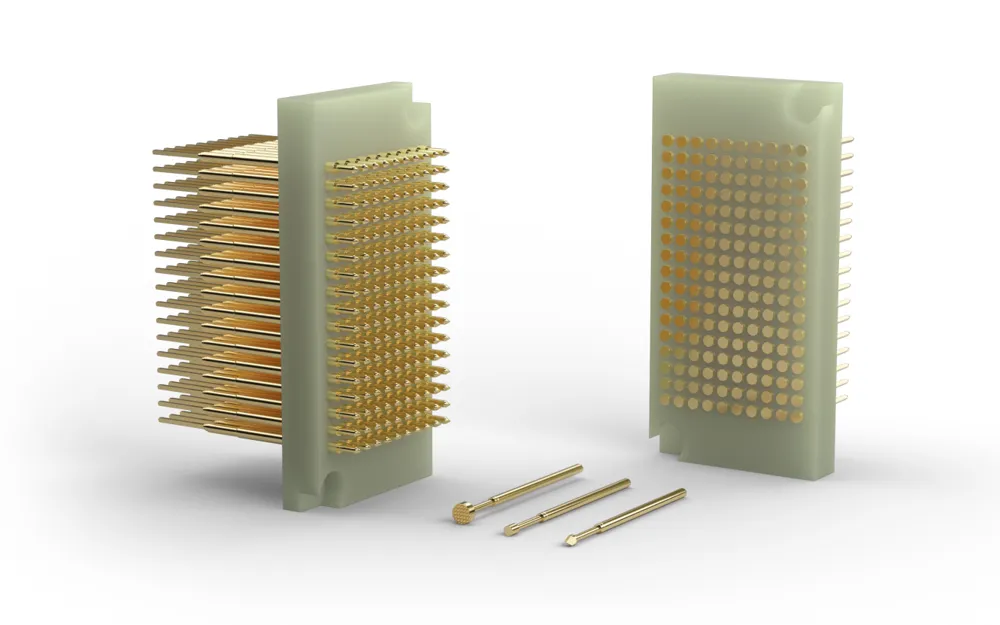
A bed-of-nails tester uses a fixture made for one board design. A plate is drilled to match the board's test-point layout and fitted with spring-loaded test probes, usually held in receptacles that are wired to the tester. The board is pressed down onto the probes, manually, pneumatically or with a vacuum, and every test point is contacted in the same press. Measurements then run without any mechanical travel between points.
That makes each board quick and repeatable to test, which is why fixtures are the usual choice for in-circuit (ICT) and functional (FCT) testing in volume. The cost is the fixture itself: it takes time to build, suits one layout, and needs rework when test points move.
Side by side
General comparison of the two methods. Actual figures depend on the tester, the board and the test program.
Which one fits your board?
Choose flying probe when
- You are testing prototypes or first articles.
- Volumes are low, or you build many different boards.
- The design is still changing between revisions.
- You need results before a fixture could be ready.
Choose bed-of-nails when
- The design is stable and test points will not move.
- Volumes are high and cycle time matters.
- Every board needs the same fast, repeatable test.
- You also want functional tests in the same fixture.
Many products use both over their life. A common path looks like this:
- Prototype and first build: test on a flying prober while the layout is still moving.
- Design freeze: lock the test-point layout and plan the fixture around it.
- Volume production: move the board to a bed-of-nails fixture for ICT or FCT.
What each method asks of the probe
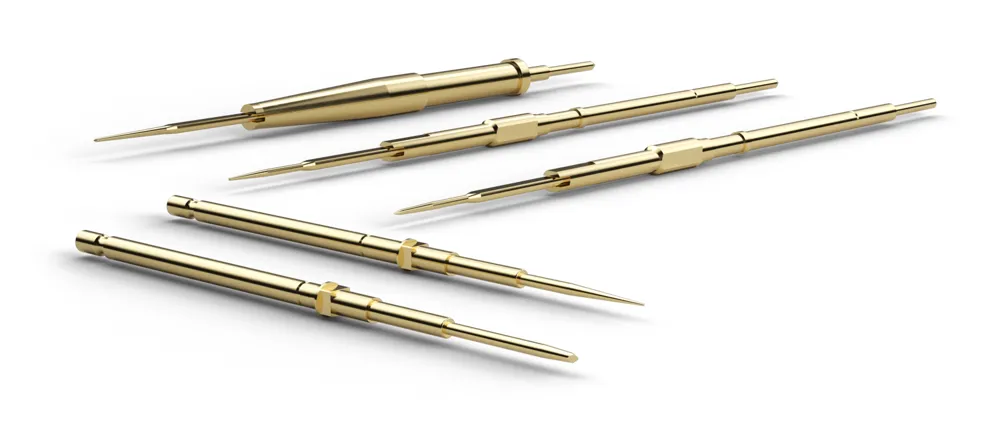
Flying probes are the contact needles used on flying probe test systems. The needle is mounted on a moving head and lands at an angle, so tip shape, spring force and pointing accuracy matter most. The EMSGLOB FL100 series suits a minimum pitch of 2.54 mm (100 mil), offers 4.3 mm of working travel, lists a pointing accuracy of ±0.08 mm and comes with flexible needle and triangular 45° tips.
EMSGLOB flying probes range (1 series), as listed on emsglob.com.
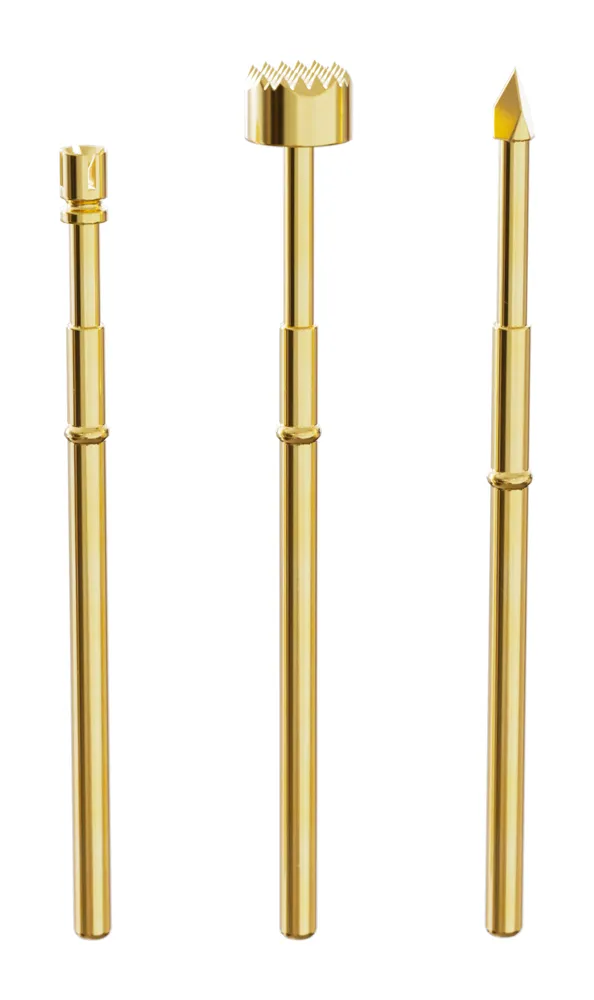
Bed-of-nails fixtures use many spring probes working together, so pitch, tip style, spring force and travel are chosen per test point, and the total force of all probes has to suit the press. EMSGLOB lists bed-of-nails test fixtures and adapters among the applications of its ICT/FCT spring test probes, including threaded, push-back and anti-rotation designs for special fixture layouts. For very dense boards, fine pitch probes cover 0.35 to 1.27 mm.
EMSGLOB ICT/FCT spring test probes range, as listed on emsglob.com.
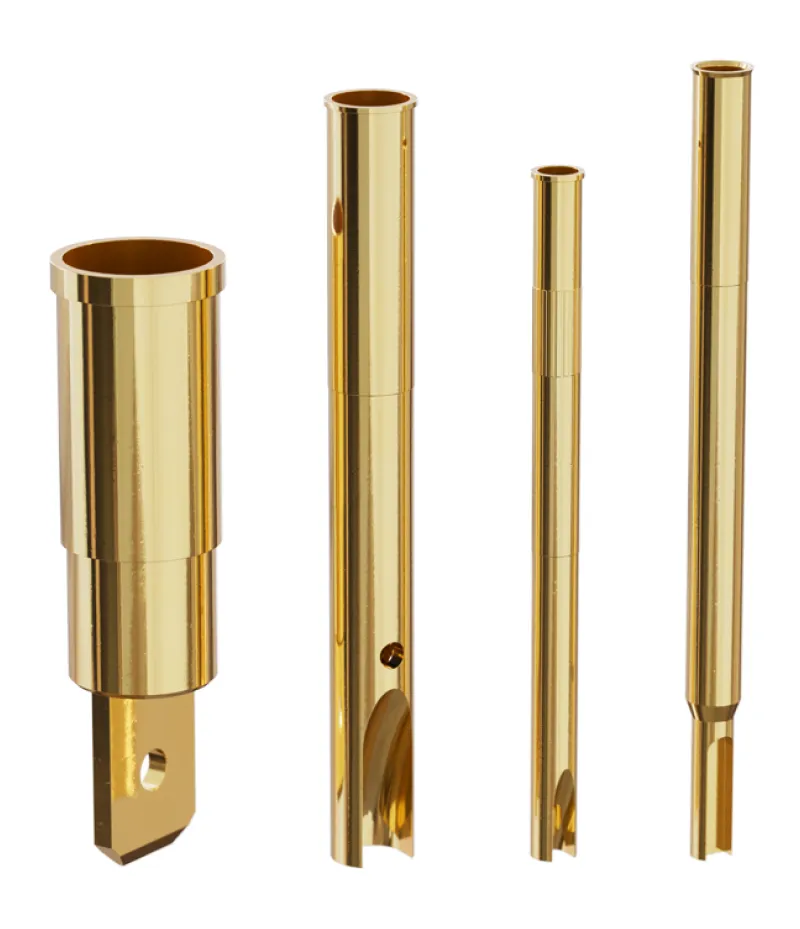
A fixture needs more than probes. Probe receptacles (44 series, 96 part numbers) hold the probes and let a worn one be swapped in seconds without desoldering the wiring. Test interface and fixture solutions (12 series, 56 part numbers) include interface probes, blocks for ICT fixtures and exchangeable cassettes. Fixture cylinders and locking devices (2 series, 25 part numbers) press, hold or lock the device under test in a defined position. For ongoing upkeep, see our guide on replacing worn test probes.
Design tips that help either method
- Give every net a test point. Neither method can measure a net it cannot reach.
- Keep test pads clear. Space them away from tall parts and board edges, and keep them free of solder mask and residue.
- Plan for a fixture early. If a board will move to bed-of-nails later, a test-point layout that respects a practical probe pitch saves rework at design freeze.
What to send for a quotation
For a fixture, send the smallest pitch on the board, the type of test points, the tip style, spring force, travel and current you need, the receptacle termination and the quantities. For flying probes, send the part number or the tip style and spring force you use. Drawings in STEP, IGES, PDF, DWG, DXF or ZIP are welcome, and EMSGLOB offers custom engineering with 3D CAD design assistance.
Email sales@emsglob.com, call +91-7383235369, or use the enquiry form on our contact page.
Keep reading
 Buyer's guideHow to Choose ICT/FCT Spring Test Probes
 How-toHow to Replace Worn Test Probes in a Fixture
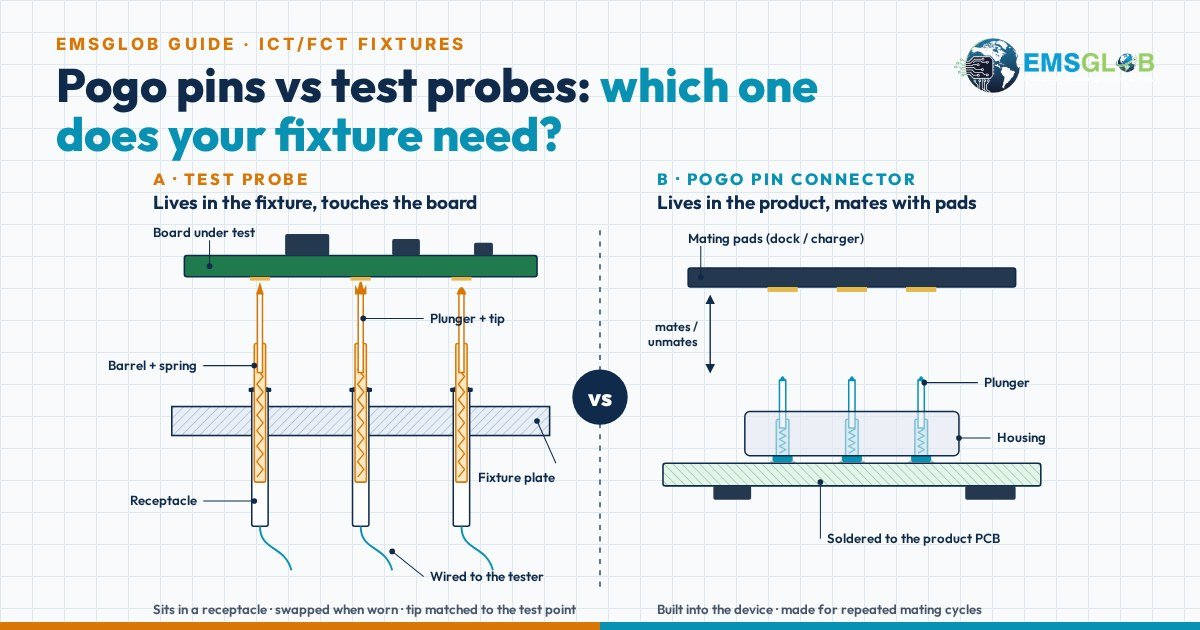 ExplainerPogo Pins vs Test Probes
Frequently asked questions
What is the difference between flying probe and bed-of-nails testing?
A flying probe tester moves a few probe heads from test point to test point and needs no dedicated fixture, so it is quick to set up and easy to change. A bed-of-nails tester presses the board onto a fixture full of spring test probes that contact every test point at once, so each board tests faster, but the fixture has to be designed and built for that board first.
When should I use flying probe testing?
Flying probe testing suits prototypes, first articles, low-volume and high-mix production, and designs that are still changing, because there is no fixture to build or rework. EMSGLOB lists its flying probes for flying probe test systems, prototype and low-volume board testing and fixtureless PCB testing.
When is a bed-of-nails fixture worth it?
A bed-of-nails fixture pays off when the design is stable and the volume is high enough that a fast, repeatable test cycle matters more than the time and effort of building the fixture. Many lines start on a flying prober and move a board to a fixture once its layout settles.
Which EMSGLOB probes are used for each method?
For flying probe systems, EMSGLOB lists the FL100 flying probe series: 4 part numbers, 2.54 mm pitch, 47.5 mm total length, 5 A rated current, with flexible needle and triangular 45° tips. For bed-of-nails fixtures, the ICT/FCT spring test probes range has 149 series and 3,372 part numbers, with pitches from 1 to 6 mm and rated currents from 0.5 to 40 A, plus probe receptacles, fixture blocks, cylinders and locking devices. Contact Rahul Desai at sales@emsglob.com or +91 7383235369.