Buyer's guide · Fixture accessories
Temperature Sensor Probes in Test Fixtures: How to Choose the Right One

Four series, one job: touch the part and read its temperature while it is held in the fixture.
In one lineSpring-loaded temperature sensors measure the temperature of a part by contact while it sits in a fixture.
Electrical tests tell you whether a board or a battery works. They do not tell you how hot it got while it was working. When a fixture pushes current through a part, or charges and discharges a cell, temperature is often the next thing you need to know. A temperature sensor probe sits in the fixture next to your test probes, presses against the part on a spring, and gives you that reading in the same press. Here is what EMSGLOB offers, how the four series differ, and how to pick one.
Where a temperature sensor probe helps
EMSGLOB lists three typical uses for its temperature sensor probes:
- Measuring part temperature during testing. Read the temperature of the device under test while the test runs, not afterwards.
- Monitoring heat build-up at contacts. Keep an eye on the contact area when a test carries current.
- Fixtures for power and battery testing. Add a temperature reading to fixtures that test power electronics or battery cells.
Because the sensor is spring-loaded like a test probe, it follows the part as the fixture closes and keeps its contact pressure while the test runs.
The EMSGLOB range at a glance
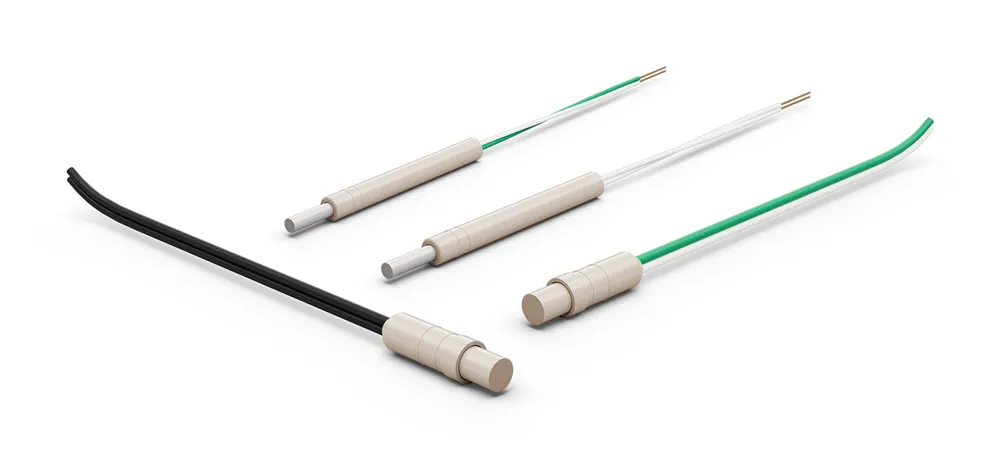
EMSGLOB temperature sensor probes range, as listed on emsglob.com. The range is grouped into sizes up to 3 mm and above 3 mm diameter.
The four series compared
Values as listed on each series page on emsglob.com. Confirm the exact data for your part number with your quotation.
In short: TS110 and TS120 fit the tighter 2.54 mm (100 mil) pitch. TS110 has the widest listed range, up to +250 °C, with a Type K sensor; TS120 has a ceramic plunger and comes with PT100 or Type K. TS300 and TS350 need a 5.00 mm (197 mil) pitch. TS300 has a flat stepped tip and four sensor options; TS350 is the shortest at 15.7 mm, has the highest listed spring force (300 cN) and offers five sensor options, including Type T.
Sensor types: match your instrument
The sensor type decides what your test system has to read, so start from the input you already have.
NTC
A thermistor whose resistance changes with temperature. Listed on TS300 and TS350 (TS350: NTC 5 kΩ).
PT100 · PT1000
Platinum resistance sensors (RTDs). PT100 on TS120, TS300 and TS350; PT1000 on TS300 and TS350.
Type K · Type T
Thermocouples, which produce a small voltage that changes with temperature. Type K on all four series; Type T on TS350.
How to choose: a short checklist
- Pitch and space. 2.54 mm pitch points you to TS110 or TS120; 5.00 mm to TS300 or TS350. Check the barrel diameter and length against the room in your fixture plate.
- Temperature range. All four start at −45 °C. TS110 is listed up to +250 °C, the others up to +200 °C.
- Sensor type. Pick NTC, PT100, PT1000, Type K or Type T to match the input on your test system.
- Contact. Compare spring force (130 to 300 cN), working travel (3 or 3.5 mm) and tip style, so the sensor touches the part firmly without marking it.
- Plunger material. Steel (TS110, TS300), ceramic (TS120) or plastic (TS350), as listed for each series.
What to send for a quotation
Send the series or part number, the quantity, your pitch, the temperature range you need, the sensor type your instrument reads, and the space available in your fixture. Drawings in STEP, IGES, PDF, DWG, DXF or ZIP are welcome.
Email sales@emsglob.com, call +91-7383235369, or use the enquiry form on our contact page.
Keep reading
 ExplainerFlying Probe vs Bed-of-Nails Testing
 Buyer's guideHow to Choose ICT/FCT Spring Test Probes
 How-toHow to Replace Worn Test Probes in a Fixture
Frequently asked questions
What is a spring-loaded temperature sensor probe?
It is a sensor built like a test probe: it sits in the test fixture and presses against the part on a spring, so it measures the part's temperature by contact while the part is held in the fixture.
Which temperature sensor probes does EMSGLOB supply?
EMSGLOB lists 4 series with 12 catalogue part numbers: TS110, TS120, TS300 and TS350, with pitches from 2.54 to 5 mm and total lengths from 15.7 to 22.8 mm.
What temperature range do they cover?
All four series start at −45 °C. TS110 is listed up to +250 °C, and TS120, TS300 and TS350 up to +200 °C.
Which sensor types are available?
NTC, PT100, PT1000, Type K and Type T, depending on the series. Type K is listed on all four series and Type T on TS350. For a quotation, contact Rahul Desai at sales@emsglob.com or +91 7383235369.